
Summary
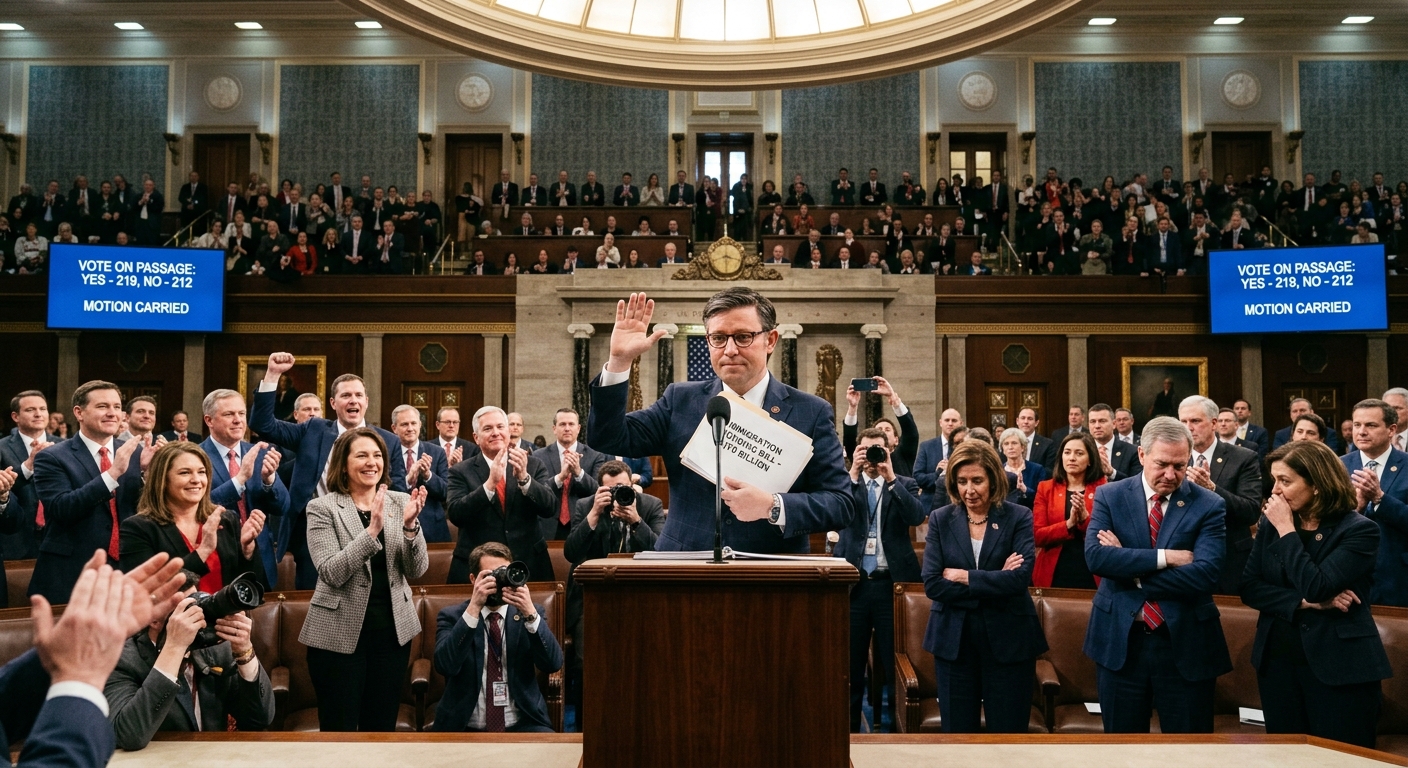
The House of Representatives passed a groundbreaking $70 billion immigration funding package aimed at enhancing resources for U.S. immigration enforcement agencies, spearheaded by House Speaker Mike Johnson. This bill, the largest of its kind, allocates crucial financial support to Immigration and Customs Enforcement (ICE) and Customs and Border Protection (CBP) during President Trump’s term. The legislation emerged after months of political gridlock over Department of Homeland Security (DHS) funding, utilizing the budget reconciliation process to circumvent typical Senate filibuster rules, which reflects significant partisan divisions.
Legislative Overview
Months of negotiating led to the passage of the funding package aimed at ICE and Border Patrol amid a contentious legislative process. Speaker Johnson strategically utilized budget reconciliation to facilitate a simple majority vote in the Senate, bypassing Democratic opposition. Although the bill passed with a narrow 52-47, it faced criticism, particularly from Democrats labeling it as lacking oversight and inadequate for comprehensive immigration reform.
Funding Allocation
This legislation represents an unprecedented funding boost for immigration enforcement, earmarking approximately $38.2 billion for ICE to enhance detention capabilities and local law enforcement partnerships. Additionally, it allocates $5 billion for border security technology. Supporters argue this increase is necessary to effectively maintain border security and enforce immigration laws, particularly given the prior funding stagnations.
Political Support and Challenges
The path to passage highlighted internal Republican divisions, with some conservatives advocating for more stringent immigration measures. Key Republicans initially withheld support due to the absence of reforms, necessitating negotiations to secure their votes. The bill succeeded in a tight vote, underscoring Speaker Johnson’s challenge in balancing party cohesion amidst ongoing dissent over immigration policy.
Public Reactions
The bill garnered mixed reactions, with advocacy organizations expressing concern over potential government overreach. Privacy advocates underscored the need for amendments to protect citizens’ rights alongside the funding discussions. The significant increase in immigration enforcement funding has prompted scrutiny regarding its broader economic implications and societal impact.
Related Legislative Context
Several related legislative measures are being considered, contextualizing the $70 billion funding package within broader governmental funding priorities. As immigration enforcement funding reaches new heights, ongoing discussions will continue to influence the legislative landscape surrounding immigration policies and funding allocation.
The content is provided by Harper Eastwood, Front Signals