
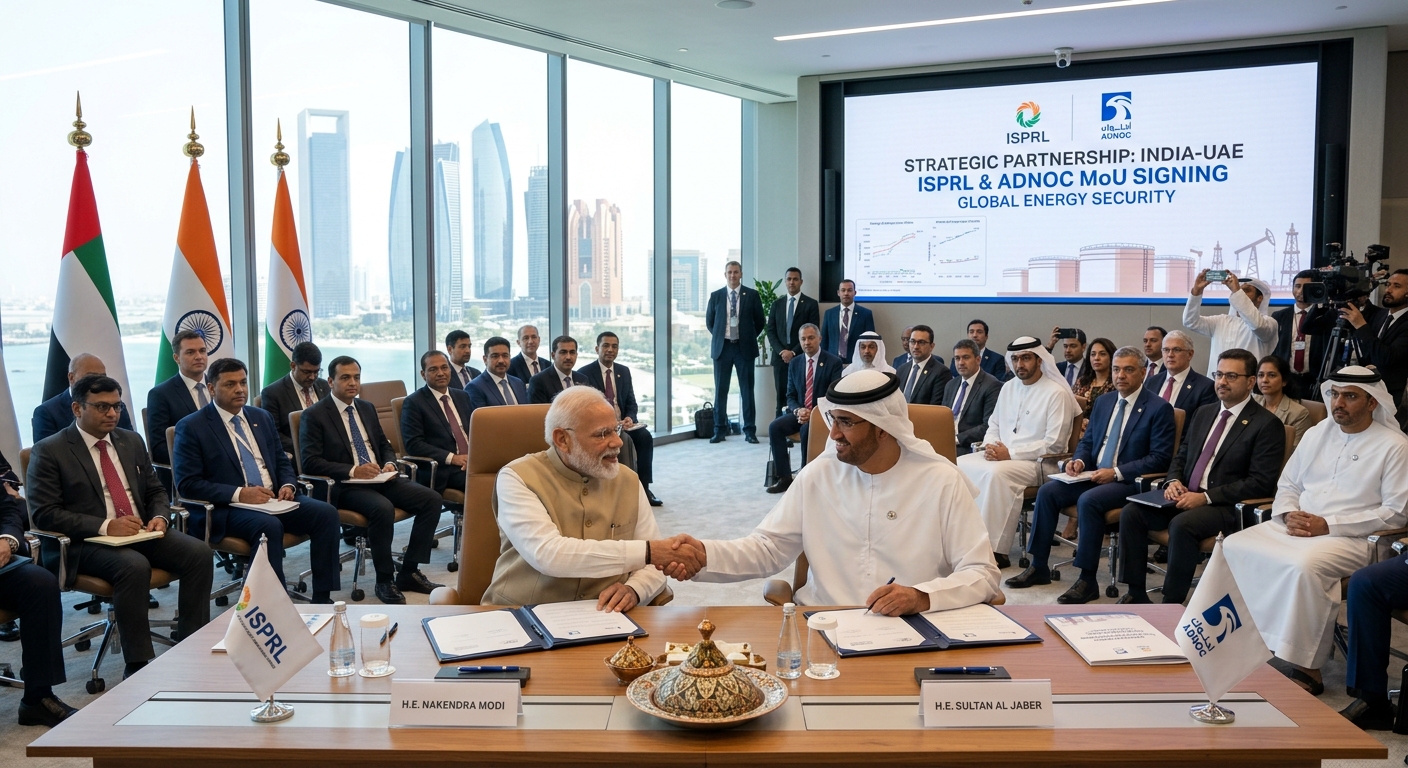
Strategic Partnership Overview
India and the UAE have established a significant partnership aimed at enhancing India’s energy security by expanding strategic petroleum reserves (SPRs) to 30 million barrels, up from approximately 5.8 million barrels. This agreement, formalized during Prime Minister Modi’s Abu Dhabi visit, not only addresses the vulnerabilities stemming from India’s reliance on crude oil imports—which constitute nearly 90% of its consumption—but also aims to create a robust buffer against global supply shocks and geopolitical tensions, particularly in crucial maritime routes like the Strait of Hormuz. The UAE’s role as a major supplier to India positions this partnership as critical in stabilizing India’s energy infrastructure.
Joint Initiative Details
The collaboration between Indian Strategic Petroleum Reserves Limited and Abu Dhabi National Oil Company focuses on a strategic reserve expansion and the exploration of strategic gas reserves. This initiative, designed to enhance India’s resilience against supply disruptions, explores commercial models allowing stored crude to be sold domestically or to other countries. While logistical and technical challenges may impact the timeline for operationalization, the initiative signifies a vital advancement in India’s energy strategy, enhancing emergency readiness and operational flexibility in managing energy resources.
Technical Storage Innovations
India’s strategic reserves will utilize advanced underground storage technologies, such as rock caverns and innovative salt cavern facilities. Rock caverns will provide secure storage, assessed for geological stability, while salt caverns—created through solution mining—offer advantages in cost-effectiveness and operational efficiency. Rajasthan has been identified as a favorable location for developing salt cavern facilities, which can enhance India’s ability to respond swiftly to supply disruptions. These innovations are crucial as India aims to significantly increase its emergency storage capacity linked to foreign investments.
Operational and Management Framework
Distinct from traditional models, the India-UAE partnership allows the UAE ownership of oil stored in India, providing emergency reserves without India bearing immediate capital costs. This dual-purpose approach enables part of the reserves to remain as national stockpiles while allowing commercial dispatches under specific arrangements. Joint infrastructure investments and collaboration in future site expansions indicate a strategic framework that extends beyond oil to include gas reserves, emphasizing comprehensive energy security and regional resilience.
Economic and Strategic Implications
The expanded energy collaboration is set to transform India’s energy landscape while enhancing UAE’s role as a vital energy supplier to one of the world’s largest economies. With strategic investments around USD 5 billion targeting various sectors in India, this partnership not only builds energy security but also fosters broader economic ties. The strategic reserves serve as critical buffers against global disruptions and position both nations to effectively manage energy supply risks while reinforcing their bilateral cooperation amid geopolitical unrest.
Challenges and Forward Outlook
While promising, the expansion initiative must navigate logistical, technological, and geopolitical challenges that could delay its full implementation. Timelines for new facility constructions will depend on specific site selections and technical evaluations. Furthermore, evolving global energy dynamics necessitate adaptable approaches to maintain the relevance and efficiency of these reserves. Together, the India-UAE partnership is regarded as a pioneering move toward enhancing energy resilience and mitigating risks associated with heavy reliance on crude oil imports, paving the way for long-term cooperative energy solutions.
The content is provided by Blake Sterling, Front Signals