E10 gasoline is cost-efficient and widely available for many vehicles.
- Consider E10 for environmental support despite a slight reduction in fuel economy.
Introduction to E10 Gas and Its Composition
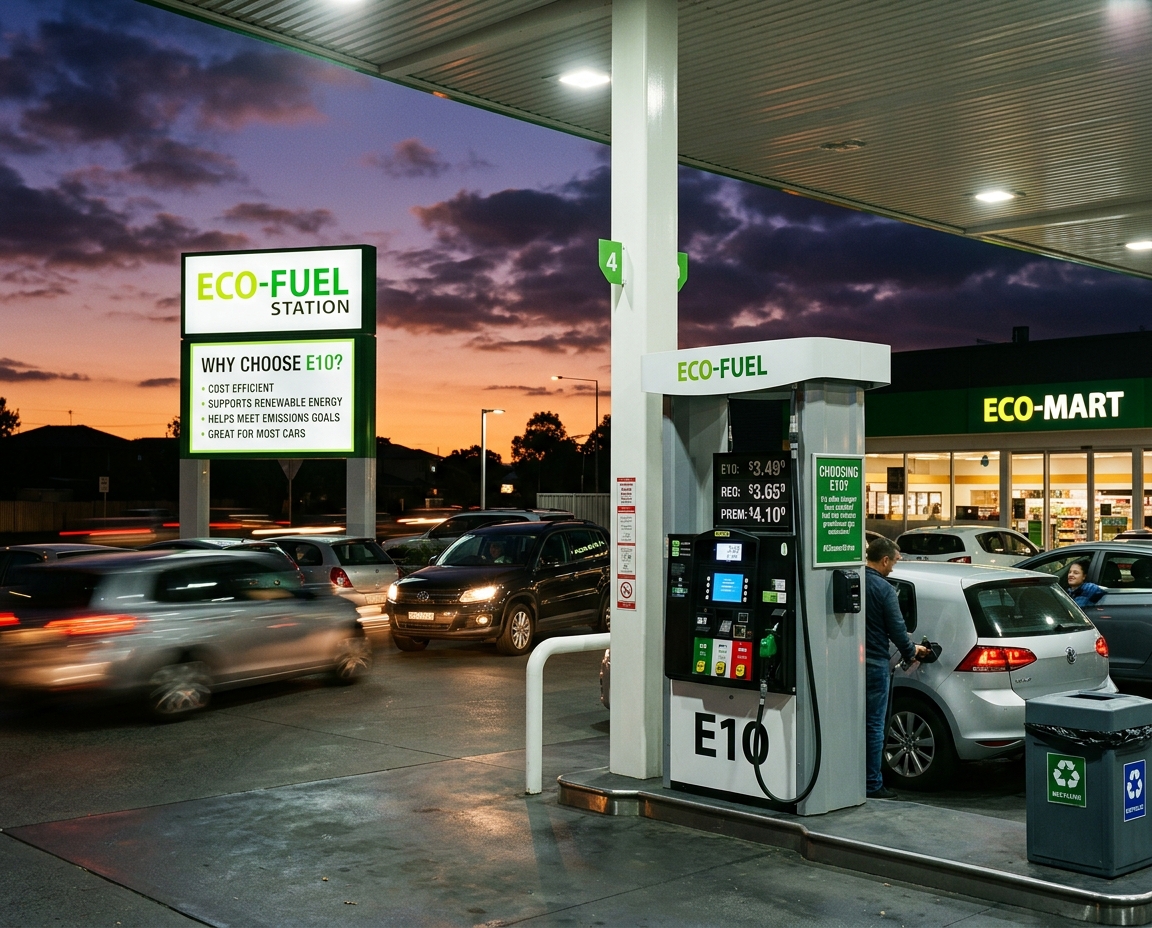
E10 gasoline is a blended motor fuel made from approximately 90 percent petroleum gasoline and 10 percent ethanol by volume. Ethanol is an alcohol fuel, commonly produced in the United States from corn, that is blended into gasoline to oxygenate the fuel, raise octane, and support renewable fuel policy goals. Today, E10 is not a niche product; it is the standard gasoline blend at many retail stations in the United States, and most conventional gasoline-powered vehicles are approved to use it. The U.S. Alternative Fuels Data Center notes that most U.S. gasoline contains up to 10 percent ethanol, used for octane, air-quality requirements, or Renewable Fuel Standard compliance.
The central issue for drivers is that ethanol and gasoline do not contain the same amount of usable energy per gallon. Ethanol has a lower energy density than petroleum gasoline, so a gallon of E10 contains slightly less energy than a gallon of ethanol-free gasoline, often called E0. This difference is small, but it is measurable in real-world fuel economy.
Understanding Fuel Economy and Its Measurement
Fuel economy describes how efficiently a vehicle converts fuel into travel. In the United States, it is commonly expressed as miles per gallon, or MPG. A vehicle rated at 30 MPG can travel about 30 miles on one gallon of fuel under standardized testing conditions, though real-world results vary with speed, temperature, traffic, tire pressure, vehicle load, maintenance, terrain, and driving style.
Because MPG is based on distance per gallon rather than distance per unit of energy, fuels with lower energy content tend to produce lower MPG when used in the same engine. This does not necessarily mean the engine is malfunctioning or that the fuel is poor quality. It means the driver may need to burn a slightly larger volume of fuel to travel the same distance. For E10, the U.S. Energy Information Administration states that vehicle fuel economy may decrease by about 3 percent compared with gasoline containing no ethanol.
Comparative Analysis of E10 versus Traditional Fuels
The most direct comparison is between E10 and E0. E0 contains no ethanol and therefore generally has higher energy content per gallon. E10 contains a renewable component and often provides octane benefits, but its lower energy density can reduce MPG. For everyday drivers, the practical impact is usually modest: a car that achieves 30 MPG on ethanol-free gasoline might achieve roughly 29 MPG on E10, depending on vehicle design and operating conditions.
Impact on Miles Per Gallon (MPG)
The MPG reduction associated with E10 is primarily a physics issue. Since ethanol contains less energy per gallon than gasoline, the blended fuel contains slightly less total energy. The U.S. Department of Energy has reported a fuel-economy decline of about 3.7 percent for E10 compared with E0, while EPA and EIA materials often describe the effect as roughly 3 percent. These values differ slightly because of assumptions about fuel composition and testing conditions, but they point to the same conclusion: E10 usually reduces MPG by a small but noticeable amount compared with ethanol-free gasoline.
However, fuel cost matters as much as MPG. If E10 is cheaper than E0 by more than the percentage loss in fuel economy, it may still cost less per mile. If ethanol-free gasoline is only slightly more expensive, some drivers—especially those operating boats, small engines, classic cars, or vehicles stored for long periods—may prefer E0 for reasons beyond fuel economy. For most modern passenger vehicles used regularly, E10 remains a practical and widely accepted fuel.
In day-to-day driving, the E10 fuel-economy penalty is often difficult to isolate because normal variation can be larger than the ethanol effect. Cold weather, aggressive acceleration, underinflated tires, roof racks, short trips, and heavy traffic can reduce MPG more dramatically than switching from E0 to E10. Therefore, drivers comparing fuels should track several tanks under similar conditions rather than relying on one fill-up.
Effect on Engine Performance
E10 generally does not harm modern vehicles designed for gasoline use. In fact, ethanol can raise the octane rating of gasoline, helping resist engine knock. Octane is not a measure of energy content; it is a measure of a fuel’s resistance to premature combustion. This means E10 can support smooth operation in engines calibrated for regular gasoline, even though it contains slightly less energy per gallon. The Department of Energy notes that some alternative fuels have higher octane properties that can help engines run smoothly, particularly when engines are designed to exploit those fuel characteristics.
For conventional engines, E10 rarely produces a noticeable change in power or drivability. The onboard engine control system adjusts fuel injection and ignition timing to maintain proper combustion. Problems are more likely in older vehicles, carbureted engines, certain marine applications, and small equipment not designed with ethanol-compatible materials. Ethanol can attract moisture and may contribute to storage-related issues if fuel sits unused for long periods. For this reason, owners should follow manufacturer recommendations, especially for motorcycles, boats, lawn equipment, and vintage cars.
Environmental Considerations of E10 Fuel Usage
E10’s environmental profile is mixed. On the positive side, ethanol is renewable in the sense that it is produced from biomass rather than directly from crude oil. Blending ethanol can reduce petroleum consumption and diversify the fuel supply. Ethanol also acts as an oxygenate, which historically helped gasoline burn more completely and supported air-quality programs. Federal renewable fuel policies, including the Renewable Fuel Standard, have encouraged ethanol use as part of a broader strategy to reduce reliance on petroleum.
At the same time, ethanol is not impact-free. Corn ethanol production involves land, water, fertilizer, farm equipment, transportation, and processing energy. Its total greenhouse-gas benefit depends on farming practices, refinery efficiency, land-use assumptions, and the energy sources used in production. Cellulosic ethanol, made from crop residues, grasses, wood waste, or other non-food biomass, is often discussed as a lower-impact pathway, but it has developed more slowly than conventional corn ethanol. The Alternative Fuels Data Center notes that cellulosic ethanol can improve ethanol’s energy balance because feedstocks may require fewer inputs and can include wastes or residues.
Conclusion: Weighing the Pros and Cons of E10 Gas
The main disadvantage of E10 is reduced fuel economy compared with ethanol-free gasoline. The loss is generally around 3 percent, meaning drivers may buy slightly more fuel to travel the same distance. For high-mileage drivers, this can matter over time, particularly if E10 and E0 are similarly priced.
The advantages are also significant. E10 is widely available, approved for use in most gasoline vehicles, supports octane needs, reduces the petroleum share of each gallon, and helps meet fuel and air-quality regulations. For most drivers of modern vehicles, E10 is a normal, reliable fuel rather than a special alternative. The best economic choice depends on price per gallon, actual MPG, vehicle compatibility, and usage pattern.
Future Trends in Fuel Economy and Alternative Fuels
The future of fuel economy will likely be shaped by several forces at once: more efficient internal-combustion engines, hybridization, electric vehicles, renewable fuels, and stricter emissions expectations. Higher-octane fuels could allow future engines to use higher compression ratios or more advanced combustion strategies, improving efficiency if engines are designed specifically for those fuels. However, simply adding ethanol to fuel does not automatically improve MPG in today’s conventional engines because energy density remains a limiting factor.
Over time, E10 may be viewed as a transitional fuel: cleaner and more renewable than pure petroleum gasoline in some respects, but less transformative than electrification or advanced low-carbon fuels. Its impact on fuel economy is real but modest. For consumers, the practical lesson is straightforward: E10 may slightly reduce MPG, but its lower price, broad availability, octane contribution, and role in reducing petroleum use can offset that drawback depending on the vehicle and driving conditions.
References
- Alternative Fuels Data Center: Ethanol Blends
- How much ethanol is in gasoline, and how does it affect fuel economy? – Frequently Asked Questions (FAQs) – U.S. Energy Information Administration (EIA)
- Fact #588: September 14, 2009 Fuel Economy Changes Due to Ethanol Content | Department of Energy
- Maximizing Alternative Fuel Vehicle Efficiency | Department of Energy
- Ethanol explained – use of ethanol – U.S. Energy Information Administration (EIA)
The content is provided by Blake Sterling, Front Signals