E10 gas offers environmental benefits but is not a complete climate solution.
- Explore E10 gas for a transitional approach to fuel sustainability.
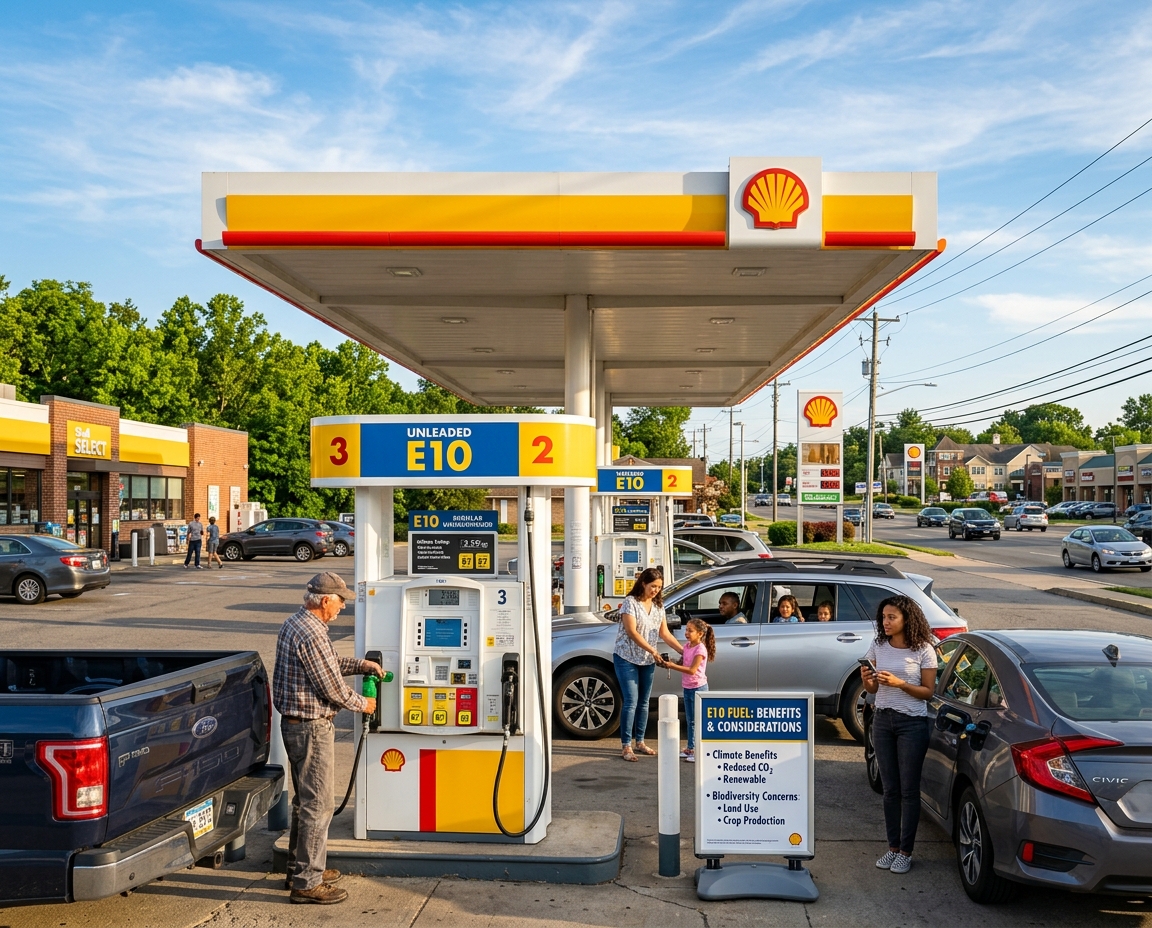
Introduction to E10 Gas and Its Composition
E10 gas is a blend of conventional gasoline and up to 10 percent ethanol by volume. Ethanol is an alcohol-based fuel most commonly produced in the United States from corn starch, though it can also be made from sugarcane, crop residues, and other biomass sources. In practical terms, E10 is not a niche fuel: the U.S. Environmental Protection Agency notes that almost all gasoline supplied in the United States today contains 10 percent ethanol.
The environmental discussion around E10 begins with its dual identity. On one hand, it remains primarily a petroleum fuel, since roughly 90 percent of the blend is gasoline. On the other hand, the ethanol portion is renewable in the sense that it is made from recently grown plant material rather than fossil carbon formed over millions of years. This gives E10 a different emissions profile from pure gasoline, but it also introduces agricultural, land-use, and water-quality considerations that do not apply in the same way to petroleum-only fuel.
Environmental Benefits of E10 Gas
One of the main environmental arguments for E10 is that ethanol can reduce reliance on petroleum. Because 10 percent of the fuel volume is supplied by ethanol, E10 displaces a portion of crude-oil-derived gasoline. This can modestly reduce demand for petroleum extraction, refining, and transport, all of which have environmental risks, including greenhouse gas emissions, oil spills, habitat disturbance, and local air pollution.
Ethanol also acts as an oxygenate, meaning it adds oxygen to the fuel mixture. Historically, oxygenated fuels helped engines burn fuel more completely, reducing carbon monoxide emissions, especially in older vehicle fleets. Modern vehicles with advanced fuel injection and catalytic converters are already much cleaner than older models, so the air-quality benefit is less dramatic than it once was. Still, ethanol blending can influence combustion chemistry and may reduce some pollutants under certain conditions.
From a climate perspective, ethanol’s potential advantage lies in its lifecycle carbon balance. Plants absorb carbon dioxide while growing, and that carbon is later released when ethanol is burned. This does not make ethanol carbon-neutral, because farming, fertilizer production, fuel processing, and transportation all require energy and can produce emissions. However, the EPA’s Renewable Fuel Standard framework evaluates renewable fuels by lifecycle greenhouse gas emissions, including feedstock production, fuel production, storage, handling, and other relevant stages.
Under the Renewable Fuel Standard, conventional renewable fuel such as corn ethanol generally must meet a lifecycle greenhouse gas reduction threshold compared with a petroleum baseline, although policy details vary depending on facility status and fuel pathway. This means E10’s environmental value depends heavily on how the ethanol is produced, the energy used in ethanol plants, crop yields, fertilizer practices, and whether land-use change is involved.
Potential Environmental Concerns Associated with E10 Gas
The most important environmental concern associated with E10 is that ethanol production is not impact-free. In the United States, most fuel ethanol is produced from corn, a crop that requires land, water, fertilizer, pesticides, farm machinery, and transport infrastructure. Intensive corn production can contribute to soil erosion, nutrient runoff, and water pollution. Nitrogen and phosphorus runoff from agricultural land can enter rivers and lakes, contributing to algal blooms and low-oxygen “dead zones” downstream.
Land use is another concern. If rising ethanol demand encourages expansion of cropland into grasslands, wetlands, or forests, the resulting carbon emissions and biodiversity losses can offset some or all of the climate benefits of replacing petroleum. Even when no direct land conversion occurs, increased demand for corn can affect crop markets and land-use decisions elsewhere. These indirect land-use effects are difficult to measure precisely, which is one reason lifecycle estimates for corn ethanol have been debated among scientists, regulators, and industry groups.
E10 may also affect evaporative and exhaust emissions in complex ways. Ethanol changes the volatility and chemical composition of gasoline. Low-level ethanol blends can influence emissions of volatile organic compounds, nitrogen oxides, particulate matter, and air toxics depending on fuel formulation, temperature, vehicle technology, and emissions-control systems. The U.S. Department of Energy notes that, like conventional fuels, ethanol blends can result in emissions of regulated pollutants, toxic chemicals, and greenhouse gases during use and storage.
Another practical environmental issue is fuel economy. Ethanol contains less energy per gallon than gasoline, so vehicles generally travel slightly fewer miles on E10 than on ethanol-free gasoline. The U.S. Energy Information Administration states that fuel economy may decrease by about 3 percent when using E10 compared with gasoline that contains no ethanol. This means drivers may need a little more fuel to travel the same distance, partly offsetting the petroleum-displacement benefit.
Comparative Analysis: E10 Gas vs. Traditional Gasoline
1. Emissions Profile
Compared with traditional gasoline, E10 typically offers a modest shift in emissions rather than a complete environmental transformation. At the tailpipe, the carbon dioxide emitted per gallon may be somewhat different because ethanol has a lower carbon intensity at combustion than gasoline, but the more meaningful comparison is lifecycle emissions. This includes crop production, fertilizer use, ethanol refining, distribution, and final combustion.
Traditional gasoline’s environmental burden is concentrated in fossil fuel extraction, refining, distribution, and combustion. Burning gasoline releases fossil carbon that was previously stored underground. E10 still releases substantial fossil carbon because it is mostly gasoline, but the ethanol fraction introduces some renewable carbon into the fuel mix. The benefit is strongest when ethanol is produced efficiently, with low-carbon energy and minimal land-use change.
Air pollutants are more complicated. E10 can reduce some emissions associated with incomplete combustion, such as carbon monoxide, especially in older engines. However, ethanol blending can also increase certain aldehyde emissions, such as acetaldehyde, and may influence evaporative emissions depending on fuel volatility controls. The EPA has studied how fuel properties, including ethanol content, aromatics, vapor pressure, and distillation characteristics, interact with vehicle technologies and emissions-control systems.
Impact on Biodiversity
The biodiversity comparison between E10 and traditional gasoline depends on which part of the supply chain is being examined. Gasoline production can harm biodiversity through oil drilling, pipeline construction, refinery pollution, road building, spills, and the broader climate impacts of fossil fuel use. These impacts may occur in marine ecosystems, forests, wetlands, grasslands, and communities near extraction or refining sites.
E10 reduces petroleum demand slightly, but it adds agricultural pressures. Large-scale corn production can simplify landscapes, reduce habitat diversity, and increase chemical and nutrient runoff. Monoculture farming can be less supportive of pollinators, birds, soil organisms, and native plant communities than more diverse agricultural or natural landscapes. If ethanol demand contributes to conversion of grasslands or marginal lands into cropland, biodiversity losses can be significant.
However, not all ethanol has the same biodiversity footprint. Ethanol made from crop residues, perennial grasses, municipal waste, or other cellulosic feedstocks could have lower land-use and habitat impacts if managed carefully. The EPA recognizes that different renewable fuel pathways require separate lifecycle evaluation because feedstocks and production processes vary. Therefore, the environmental profile of E10 is not fixed; it depends on the source and production method of the ethanol blended into the gasoline.
Conclusion: Weighing the Environmental Impact of E10 Gas
E10 gas offers limited but real environmental advantages over traditional gasoline when the ethanol component is produced responsibly. It can reduce petroleum consumption, modestly alter greenhouse gas emissions, and support the use of renewable fuel within the existing vehicle and fueling infrastructure. Because nearly all U.S. gasoline already contains about 10 percent ethanol, E10 has become a mainstream transitional fuel rather than a specialized alternative.
At the same time, E10 should not be viewed as a comprehensive climate or biodiversity solution. It is still mostly gasoline, and its benefits can be weakened by lower fuel economy, fertilizer-related emissions, water pollution, land-use change, and habitat impacts from feedstock production. Its environmental performance is best understood as a balance between reduced petroleum dependence and added agricultural pressures.
Overall, E10 is generally preferable to traditional gasoline in some respects, particularly when ethanol is produced with efficient farming, cleaner process energy, and strong land-conservation safeguards. Yet its benefits are modest compared with deeper transportation changes such as improved fuel efficiency, reduced vehicle miles traveled, public transit, electrification powered by low-carbon electricity, and advanced low-carbon fuels. The environmental case for E10 is therefore conditional: it can be part of a lower-impact fuel strategy, but it is not by itself a long-term solution to the environmental costs of transportation.
References
- Learn about Gasoline | US EPA
- Lifecycle Analysis of Greenhouse Gas Emissions under the Renewable Fuel Standard | US EPA
- Overview for Renewable Fuel Standard | Renewable Fuel Standard Program | US EPA
- Alternative Fuels Data Center: Ethanol Vehicle Emissions
- How much ethanol is in gasoline, and how does it affect fuel economy? – Frequently Asked Questions (FAQs) – U.S. Energy Information Administration (EIA)
The content is provided by Harper Eastwood, Front Signals