E10 gas provides environmental and economic benefits for everyday drivers.
- Consider compatibility and fuel economy before choosing E10 for your vehicle.
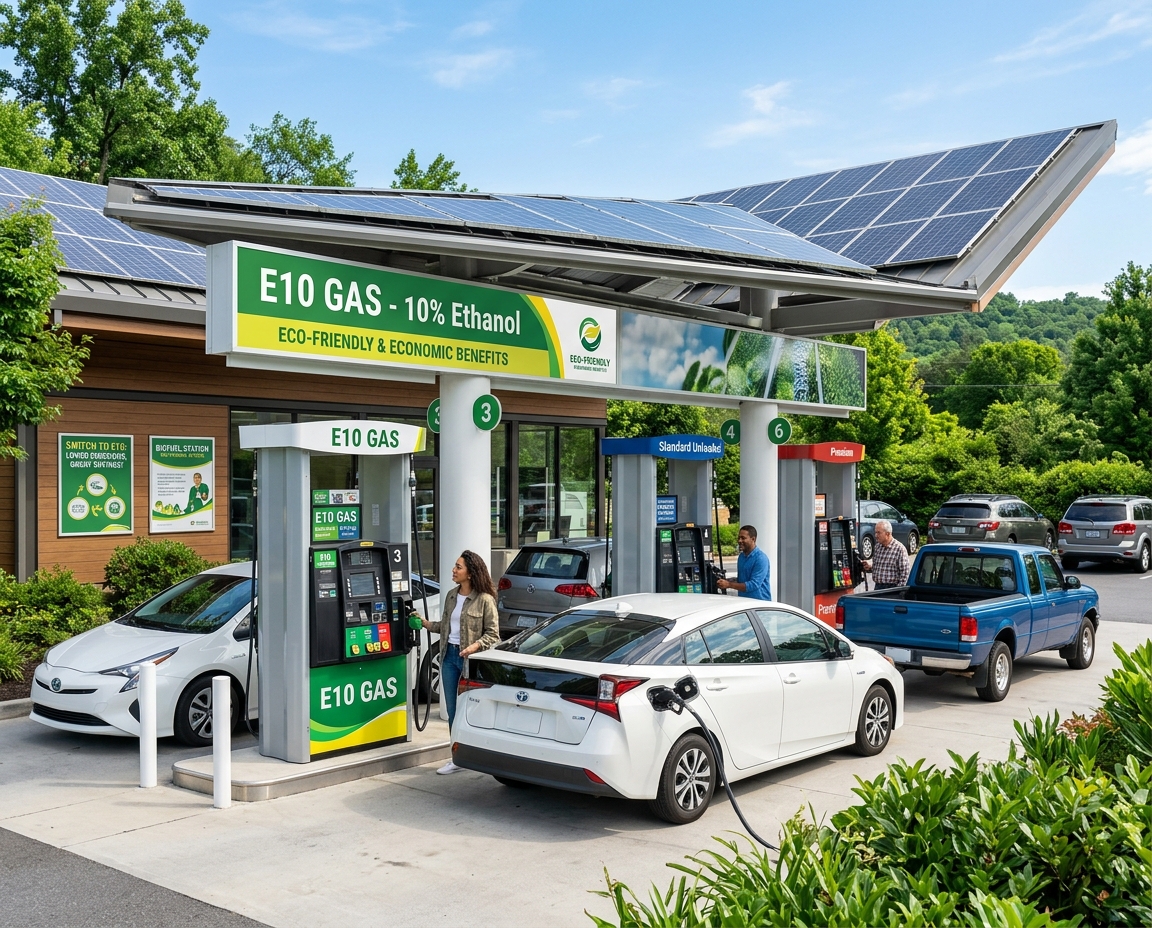
Introduction to E10 Gas: What You Need to Know
E10 gas is one of the most common fuels used in modern gasoline-powered vehicles. The name “E10” means that the fuel contains up to 10 percent ethanol and about 90 percent petroleum-based gasoline. For many drivers, E10 is simply the regular gasoline available at the pump, often without much thought about its composition or effects. In the United States, most gasoline sold for use in conventional gasoline engines contains ethanol, and E10 has long been the dominant blend in everyday retail fuel markets. The U.S. Energy Information Administration has reported that gasoline blended with 10 percent ethanol accounts for the overwhelming majority of fuel consumed by gasoline-powered motor vehicles.
The widespread use of E10 reflects a combination of energy policy, fuel chemistry, agricultural production, and environmental regulation. Ethanol can help gasoline burn more completely, raise octane levels, and reduce reliance on petroleum. At the same time, E10 has limitations, including slightly lower fuel economy and concerns for older engines, small equipment, marine engines, and fuel storage. Understanding both the benefits and drawbacks helps consumers make informed decisions about vehicle maintenance, fuel costs, and environmental impact.
Understanding E10 Gas: Composition and Usage
E10 is a low-level ethanol blend made from approximately 10 percent ethanol and 90 percent gasoline. Ethanol is an alcohol fuel, commonly produced in the United States from corn starch, although it can also be made from other plant-based feedstocks. The U.S. Department of Energy’s Alternative Fuels Data Center identifies E10 as a standard low-level ethanol blend approved for use in conventional gasoline-powered vehicles.
Ethanol is blended into gasoline for several reasons. First, it acts as an oxygenate, meaning it adds oxygen to the fuel mixture and can support more complete combustion. Second, ethanol has a relatively high octane rating, which helps resist engine knock. Third, ethanol blending supports compliance with federal fuel programs such as the Renewable Fuel Standard, which is administered by the Environmental Protection Agency. EPA materials explain that renewable fuels must meet defined requirements, including lifecycle greenhouse gas considerations, to qualify under the program.
For most modern cars and light-duty trucks, E10 can be used without special modifications. This distinguishes it from higher ethanol blends such as E85, which are designed for flex-fuel vehicles, or E15, which has specific approval limits and labeling rules. E10 is therefore not a niche or experimental product; it is the default gasoline blend in many markets. However, because ethanol behaves differently from pure gasoline, its effects on engines, fuel economy, emissions, and storage are not identical to ethanol-free fuel.
Benefits of E10 Gas: Environmental and Economic Advantages
One of the main benefits of E10 is that it can reduce petroleum consumption. Since 10 percent of the fuel volume comes from ethanol, a portion of the energy supply is derived from a domestically produced renewable component rather than crude oil. In countries with large agricultural sectors, particularly the United States, ethanol production also creates demand for crops and supports rural economies through farming, transport, refining, and blending infrastructure.
E10 can also contribute to cleaner combustion in certain respects. The EPA notes that gasoline standards, including programs involving oxygenates, are designed to reduce harmful emissions such as those contributing to ground-level ozone, smog, and carbon monoxide. Historically, oxygenated fuels were especially important in winter gasoline programs because they helped reduce carbon monoxide emissions from inefficient cold-weather combustion.
Another advantage is octane improvement. Ethanol has a high octane value, so blending it with gasoline can help refiners produce fuels that meet required octane ratings. Higher octane helps prevent premature ignition, or knocking, in gasoline engines. This does not mean E10 automatically improves performance in every vehicle, but it does help fuel suppliers meet engine requirements while reducing the need for some petroleum-derived octane enhancers.
From an energy-security perspective, E10 diversifies the fuel supply. Because ethanol is produced domestically in the United States, it can reduce dependence on imported petroleum and provide refiners with another blending component. This is particularly significant in a transportation system still heavily reliant on liquid fuels. Even as electric vehicles expand, gasoline-powered vehicles remain a large part of the passenger and commercial fleet, making incremental changes in fuel composition relevant at national scale.
E10 may also have price advantages in some markets. Ethanol has often been used as a cost-effective blending component, though the actual price effect depends on corn prices, oil prices, refining costs, tax policy, regional supply, and distribution infrastructure. When ethanol is cheaper than petroleum gasoline blendstock, E10 can help moderate retail gasoline prices. However, the price benefit is not guaranteed at all times or in all regions.
Drawbacks of E10 Gas: Potential Risks and Concerns
The most widely recognized drawback of E10 is lower fuel economy compared with ethanol-free gasoline. Ethanol contains less energy per gallon than gasoline, so a gallon of E10 typically provides slightly less usable energy than a gallon of E0. The U.S. Energy Information Administration states that vehicle fuel economy may decrease by about 3 percent when using E10 compared with gasoline that contains no ethanol.
This fuel-economy penalty is usually modest for ordinary driving, but it matters when comparing real fuel costs. If E10 is cheaper than ethanol-free gasoline, the lower price may offset the reduced mileage. If the price difference is small or nonexistent, ethanol-free gasoline may deliver more miles per gallon, though it is often less available and may cost more at the pump.
Another concern is compatibility with older vehicles and certain types of equipment. Most modern gasoline vehicles are designed to tolerate E10, but older cars, classic vehicles, motorcycles, boats, lawn mowers, chainsaws, snowblowers, and other small engines may be more sensitive to ethanol-blended fuel. Ethanol can act as a solvent, potentially loosening deposits in older fuel systems. It can also interact with some rubber, plastic, fiberglass, or metal components that were not designed for ethanol exposure.
Fuel storage is another important issue. Ethanol is hygroscopic, meaning it attracts and absorbs water. When ethanol-blended fuel sits for long periods, especially in humid environments or partially filled tanks, water contamination can become a problem. In severe cases, phase separation can occur, where the ethanol-water mixture separates from the gasoline. This can lead to poor engine operation, corrosion, or starting problems. For vehicles driven regularly, this risk is usually low because fuel is consumed and replaced frequently. For seasonal equipment and boats, the risk is higher.
E10 also raises broader environmental questions. While ethanol is renewable in the sense that it is produced from plant material, its full environmental value depends on the lifecycle impacts of crop production, fertilizer use, land use, processing energy, and transportation. EPA’s Renewable Fuel Standard framework evaluates renewable fuels using lifecycle greenhouse gas analysis, which reflects the fact that emissions are not limited to tailpipe combustion alone.
There are also debates about food, land, and agricultural impacts. Corn ethanol production can support farmers and rural economies, but it also links fuel markets to crop markets. Critics argue that large-scale corn ethanol demand can affect land use, water use, fertilizer runoff, and commodity prices. Supporters respond that ethanol production has become more efficient over time and that co-products such as distillers grains are used as animal feed. The net effect depends on farming practices, production technology, and policy design.
Conclusion: Weighing the Pros and Cons of E10 Gas
E10 gas is a practical compromise between conventional petroleum gasoline and renewable fuel blending. Its major advantages include reduced petroleum use, support for domestic ethanol production, octane enhancement, and potential emissions benefits in some combustion conditions. It is widely available and approved for use in conventional gasoline-powered vehicles, making it a normal part of modern transportation fuel systems.
At the same time, E10 is not without disadvantages. It generally delivers slightly lower fuel economy than ethanol-free gasoline, may create problems in older or ethanol-sensitive engines, and requires care when stored for long periods. Its environmental benefits also depend on the full lifecycle of ethanol production, not just the fact that ethanol is plant-derived.
For most drivers of modern vehicles, E10 is safe, common, and largely unavoidable in many regions. The best approach is to follow the vehicle manufacturer’s fuel recommendations, avoid storing ethanol-blended fuel for excessive periods, and consider ethanol-free gasoline for classic vehicles, marine engines, or small seasonal equipment when appropriate. Ultimately, E10 offers real benefits, but those benefits must be balanced against its practical limitations in fuel economy, storage stability, and equipment compatibility.
References
- Almost all U.S. gasoline is blended with 10% ethanol – U.S. Energy Information Administration (EIA)
- Alternative Fuels Data Center: Ethanol Blends
- Overview of the Renewable Fuel Standard Program | US EPA
- Learn about Gasoline | US EPA
- How much ethanol is in gasoline, and how does it affect fuel economy? – Frequently Asked Questions (FAQs) – U.S. Energy Information Administration (EIA)
The content is provided by Jordan Fields, Front Signals