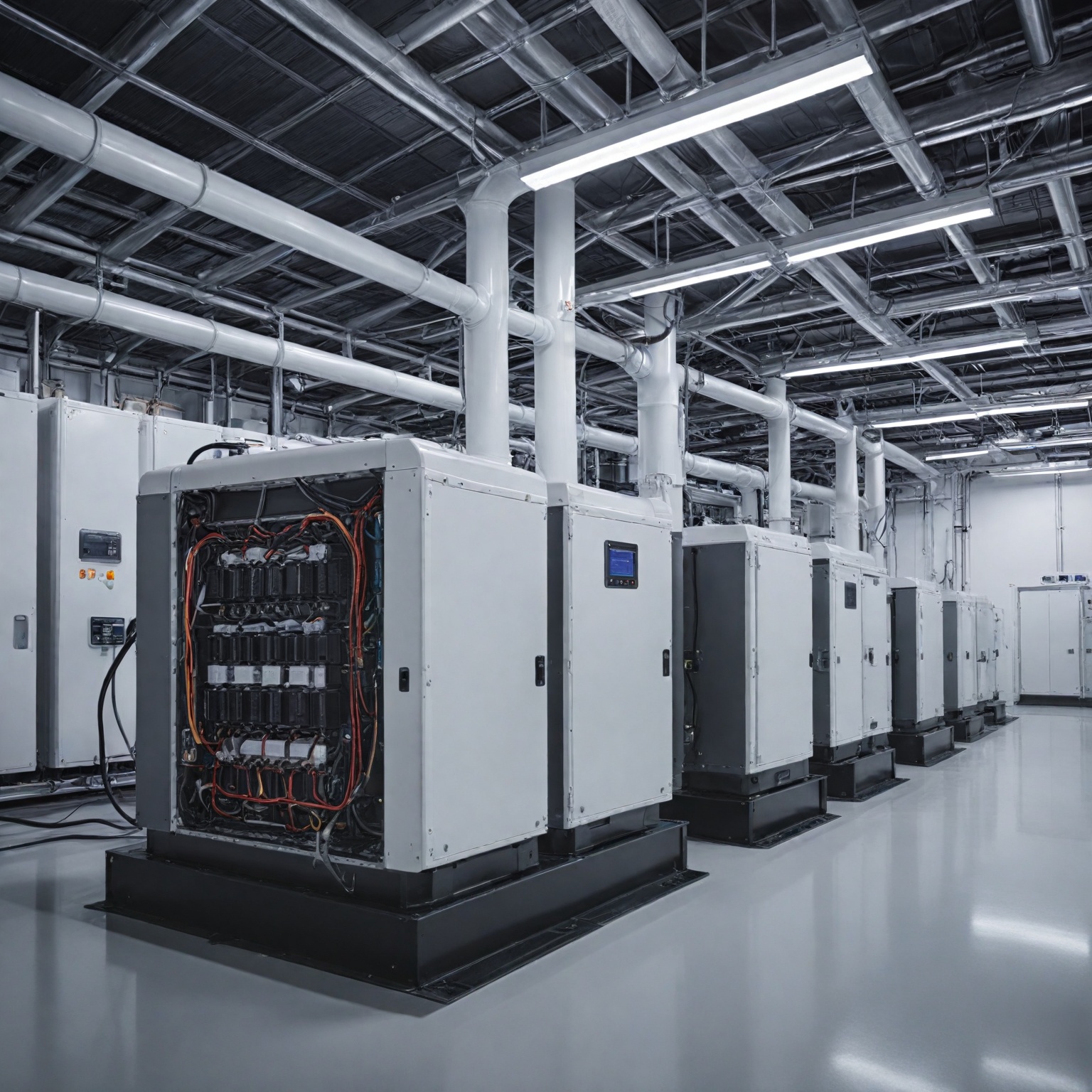
Summary
Unleashing the Future: Revolutionary Liquid Cooling for Battery Energy Storage is a comprehensive overview of the applications, benefits, and challenges of liquid cooling systems in battery energy storage. These systems, which utilize a mixture of water and glycol to dissipate heat, are a crucial aspect of thermal management in batteries, particularly in high-energy density environments such as large-scale energy storage stations and electric vehicles . The technology allows for uniform temperature control, increased safety, and improved battery longevity . Despite these benefits, liquid cooling systems come with their own set of challenges including high implementation costs, maintenance complexities, and the need for specialized expertise .
The page highlights significant advancements in liquid cooling technology and how it plays a pivotal role in renewable energy storage systems, particularly those that integrate with solar and wind energy sources . Key players in the field, such as MeritSun and COMSOL®, are also discussed for their contributions to the evolution of this revolutionary technology . Additionally, the page discusses the various factors to consider when selecting a cooling liquid for battery energy storage applications, including system efficiency, safety, scalability, and energy density .
Market trends and future prospects of liquid cooling systems are also explored, with estimates indicating a burgeoning demand for the technology in the global energy storage temperature control market . Lastly, the page provides a comparative analysis between air cooling and liquid cooling, discussing the strengths and weaknesses of both systems, along with the emerging concept of hybrid cooling systems .
Background
Battery energy storage systems (BESS) have traditionally employed two types of cooling systems for thermal management: air cooling and liquid cooling . Each has unique advantages and is more suitable for specific scenarios .
Air cooling involves the use of low-temperature air as the medium, often facilitated by fans, to generate heat convection with the battery cells, thereby reducing the battery temperature . The design of air-cooled energy storage systems is relatively simple, typically involving the installation of cooling fans and the design of airflow paths . Despite being a simple and energy-efficient method, natural air cooling suffers from poor cooling performance and low energy utilization efficiency, making it less preferable in certain applications . Nonetheless, air cooling remains mainstream, especially in medium to low power scenarios with low heat dissipation requirements, such as residential energy storage systems and small backup power supplies .
Liquid cooling, on the other hand, employs a liquid medium—typically a mixture of water and glycol—to exchange heat and reduce battery temperature . This method boasts high cooling efficiency and allows more uniform temperature control across various components . In addition to this, liquid cooling can prevent hot spots and minimize the risk of thermal runaway, a phenomenon that could lead to catastrophic failure in battery cells . This is a critical factor in environments where safety is of utmost importance, such as residential and commercial installations . Components of an energy storage liquid cooling system usually include a liquid cooling plate, a liquid cooling unit, a liquid cooling pipeline equipped with a temperature sensor and a valve, as well as high and low voltage wiring harnesses .
Liquid cooling systems are particularly beneficial in scenarios with high battery pack energy density, fast charging and discharging rates, and significant environmental temperature fluctuations . This makes them suitable for high-power, high-density, or high-temperature environments such as large-scale energy storage stations and electric vehicles . However, these systems can produce higher noise levels, leading to potential environmental impact .
While air cooling and liquid cooling are the most commonly used thermal management schemes in energy storage systems, others like heat pipe cooling and phase change cooling are currently in the experimental stages . There are also hybrid cooling systems, which utilize a combination of different cooling techniques to meet the specific thermal management needs of a battery pack . These systems can be designed to adapt to different operating conditions and can be optimized to handle various thermal loads efficiently .
Advancements in Liquid Cooling for Battery Energy Storage
Liquid cooling has emerged as a vital component for battery energy storage systems, especially those deployed in conjunction with renewable energy sources such as solar and wind. The primary advantage of liquid cooling is its ability to maintain stable battery performance amidst temperature fluctuations, thereby enhancing the overall longevity of the energy storage system.
Higher Energy Density and Enhanced Thermal Management
With the integration of liquid cooling, a more compact design for energy storage systems is possible. It results in a higher energy density as more energy can be stored in a given physical space, giving liquid-cooled systems an edge over air-cooled counterparts, particularly in situations with space constraints. Moreover, the superior thermal management capabilities of liquid cooling allow precise control over the temperature of battery cells, ensuring optimal operation within a specific temperature range.
Improved Safety
From a safety perspective, efficient thermal management plays a crucial role in energy storage systems. Compared to air-cooled systems, liquid-cooled battery energy storage systems provide better protection against thermal runaways.
Despite the notable benefits, challenges pertaining to implementation costs, maintenance complexities, and the need for specialized expertise exist. However, future developments in materials and manufacturing processes could address these concerns, making liquid-cooled systems more accessible and cost-effective.
Market Trends and Future Prospects
Technologies like the PowerTitan series by Sungrow Power Supply Company underscore the potential of liquid-cooled alternatives over traditional air-cooled energy storage systems. According to estimates, the value of China’s energy storage temperature control industry is projected to reach nearly 16.5 billion RMB in 2025, with liquid cooling systems accounting for approximately 45%.
The emergence of the scale effect is expected to decrease the unit value of both air cooling and liquid cooling systems. Nevertheless, due to its safety, efficiency, and flexibility, battery liquid cooling system technology is gradually evolving into a mainstream application in incremental energy storage scenarios.
Considering the current pace of development in liquid cooling technology, the global energy storage temperature control market is expected to reach 9.4 billion RMB by 2025. This continuous pursuit of innovation in energy storage technologies signifies the importance of liquid-cooled energy storage battery systems in shaping the landscape of renewable energy storage in the future.
Comparative Analysis
Air Cooling vs Liquid Cooling
Air cooling systems function through the use of low-temperature air as a cooling medium, using natural wind or fans to generate heat convection with battery cells to lower their temperature. The design of air-cooled energy storage systems is relatively straightforward, primarily involving the installation of cooling fans and the design of airflow paths. However, despite their advantages in cost and maintenance, air cooling systems suffer from weaker performance in heat dissipation efficiency and temperature uniformity.
Hybrid Cooling Systems
Hybrid cooling systems, which combine different cooling technologies, can be customized to meet specific thermal management needs of a battery pack. These systems can be designed to adapt to different operating conditions and can handle various thermal loads efficiently.
Real-World Applications of Liquid Cooling in Battery Energy Storage
In the context of renewable energy sources like solar and wind, liquid-cooled energy storage systems play a vital role. They offer reliable energy storage solutions capable of handling high power demands and guaranteeing stable performance, even amidst temperature fluctuations.
Liquid-cooled battery packs are also finding increased usage in large-scale energy storage systems for commercial and industrial applications. However, designing these systems requires specialized expertise and careful consideration of factors such as implementation costs and maintenance complexities. Future advancements in materials and manufacturing processes are anticipated to address these challenges and make liquid-cooled systems more accessible and cost-effective.
Furthermore, in the competitive world of energy storage integrators, the ability to design non-standard products is key. Liquid cooling temperature control needs to be jointly developed with battery pack layout and liquid cooling pipeline design, thus integrating it with the battery.
In the early stages of new energy vehicle development, the principles of fuel vehicle design were adopted for electric vehicle manufacturing. Back then, passive methods such as airflow and heat sinks were sufficient for battery cooling. But with the rising heat production from the motor, battery, and charging systems, more efficient methods like liquid cooling have become essential.
Auxiliary power supplies, switches, connectors, UPS, and auxiliary power connections to the auxiliary loads (like the liquid cooling system) are important aspects of this real-world application. Furthermore, to offer one universal communication interface for battery systems with SCADA or EMS, system controllers are deployed as part of the battery energy storage system integration.
Challenges and Solutions
Challenges
Despite numerous advantages, liquid-cooled energy storage systems also come with certain challenges. Key concerns include implementation costs, complexities in maintenance, and the requirement for specialized expertise. These factors need to be considered and addressed carefully for optimal operation. Furthermore, the practice of battery thermal management system also faces certain challenges which need identification and solution development.
Solutions
Addressing these challenges may require various approaches, including the development of new materials, advancements in manufacturing processes, and the exploration of innovative designs. For instance, a novel topology optimization design method inspired by a bionic leaf-vein structure has been proposed for the liquid cooling plate of lithium-ion batteries. Such a design could enhance the safety and effectiveness of the batteries, particularly under extreme working conditions.
Further, advances in simulation and modelling tools, like COMSOL® products, can help develop and solve high-fidelity models of liquid-cooled Battery Energy Storage Systems (BESS), providing key insights to overcome practical challenges.
Role of Liquid-Cooling Systems
The specific heat capacity of water makes liquid-cooling systems particularly efficient in controlling temperature, preventing hot spots, and minimizing the risk of thermal runaway, thereby enhancing safety. Such systems can even make energy storage solutions more compact, reducing the overall space required by about 32 percent compared to standard systems. These systems can also optimize radiator design and layout to reduce noise and environmental impact.
Liquid cooling technology’s applicability extends to various types and scales of energy storage systems, especially those requiring high-energy density and rapid charging/discharging rates. It is particularly useful for large-scale energy storage stations, electric vehicles, and environments with substantial temperature fluctuations.
Technological Components
Key components of energy storage liquid cooling systems include the cooling plate, cooling unit, cooling pipeline with sensors and valves, and cooling liquid, typically an ethylene glycol aqueous solution. In operation, the cooling liquid flows through channels in the cooling plate, directly absorbing heat from the battery cells to ensure a uniform temperature distribution.
Selection Criteria for Cooling Liquid in Battery Energy Storage Applications
Choosing the right cooling solution for battery energy storage systems is crucial. Thermal management is a vital aspect of such systems, and the use of liquid cooling has emerged as a transformative technology in this field . The selection of cooling liquid in battery energy storage applications entails consideration of various factors, including the cooling system’s efficiency, safety, scalability, and energy density.
One of the key considerations is the system’s thermal management capabilities. Efficient thermal management plays a significant role in ensuring the safety and longevity of energy storage systems . Liquid cooling provides superior thermal management compared to air cooling. It allows for precise control over the temperature of battery cells, ensuring they operate within an optimal temperature range. This helps to prevent hot spots and minimizes the risk of thermal runaway, a phenomenon that can lead to catastrophic failure in battery cells .
Energy density is another crucial criterion. Liquid cooling allows for more compact design and better integration of battery cells, which often results in higher energy density compared to air-cooled counterparts . Enhanced energy density means more power can be stored in a given space, which is particularly advantageous for energy storage applications.
Furthermore, liquid-cooled systems offer the advantage of scalability. The ability to efficiently cool individual battery cells enables the creation of modular units that can be easily combined to scale up storage capacity . This makes it possible to adapt energy storage solutions to the varying needs of different applications, from residential setups to large-scale grid storage facilities.
The efficiency of the cooling system is also a key factor to consider. As the coolant in liquid cooling systems has higher heat capacity and thermal conductivity than air, the heat exchange process is more direct, efficient, and closed . Therefore, liquid cooling offers better temperature control and heat dissipation effects than air cooling.
However, there are some challenges associated with the implementation of liquid-cooled systems, such as cost, maintenance complexities, and the need for specialized expertise . These are factors that must be addressed when selecting a cooling liquid for battery energy storage applications.
Lastly, the environmental impact of the cooling solution should also be taken into account. The development of environmentally friendly coolants and closed-loop cooling systems can minimize the environmental impact of liquid cooling technology, making it a more sustainable solution .
Key Players in the Field of Liquid Cooling for Battery Energy Storage
One of the prominent players in the field of liquid cooling for energy storage systems is MeritSun. With 24 years of experience in lithium battery production and manufacturing, MeritSun has dedicated decades to researching high and low-temperature control technology for energy storage systems . Currently, all of MeritSun’s large-scale energy storage systems utilize cutting-edge liquid cooling technology .
Another noteworthy contributor in this domain is COMSOL®, a company that provides the tools required to model thermal management applications. Their products aid in determining the right combination of boundary conditions, material properties, physics interfaces, and part libraries for efficient thermal management . These products are also essential for modeling the complexities involved in liquid cooling systems.
With the advancements in technology, liquid cooling is becoming an increasingly common method of thermal management in energy storage systems . Companies like MeritSun and COMSOL® are paving the way towards harnessing the full potential of liquid cooling for enhanced battery performance and longevity. These key players, with their continuous research and development efforts, are unlocking the future of revolutionary liquid cooling technology for battery energy storage .
The content is provided by Avery Redwood, Brick By Brick News